INTRODUCTION
Power and trade share a direct relationship with each other. The concept of power allows those with the capacity to exert influence and control over another entity. The power dynamics between global supply chains, economic and fiscal policies, and political influence all define the sphere of global trade. States with a much stronger position in the global economy leverage their might over a state with lesser influence to serve their own agenda. Dominant states have historically leveraged their way into influencing certain economic conditions that allow them to influence trade. This literature review pursues the nuanced relationship of power and trade through different perspectives and data. Within this review there will be an examination of a handful of theories that can better contextualize the relationship between power and trade.
THEORETICAL PERSPECTIVES
When trying to understand the relationship between power and trade, it is important to note the two perspectives from which the literature has taken. There is the Realist perspective, where power and economic leverage should be used to achieve the state’s goals. Then there is the liberal perspective, where the role of the state is integral in that the more complex and rooted trade relationships between other states are, the less likely conflict will arise. An example of a Realist perspective is the Hegemonic Stability Theory. (Krasner, 1976) suggests that powerful states influence trade through their interests and capability to establish and maintain an interdependent trade system. Rather than economic power, Krasner argues that political power plays a more crucial role in shaping international economic policy. Essentially, the United States hegemony allows there to be an open and free trade system; if that power were to decline, then we would see more protectionist and isolationist policies.
Power Transition Theory shares similar features to Krasner’s theory but is a slightly more liberal perspective in that it recognizes an imbalance in power and seeks to either reject or pursue change. According to (Nguyen, Sattler, and Schweinberger, 2024), power transitions through states that are in fluctuation. This transition gives way to conflict as those rising in power seek to gain influence by disrupting the status quo. They suggest that the assertion of national interests in trade policy, coupled with influence from citizens, allows those in the rising power to be more supportive of bilateral economic cooperation than citizens in the declining power. This Power Transition Theory implies that “citizens should become more skeptical of trade cooperation with another country if their country declines relative to the other.” (Nguyen, Sattler, and Scheweinberger, 2024) This source looks comparatively at China and the United States, nations that are both rising and declining in certain aspects within the economy. Upholding U.S. hegemony leads to more conservative policies that will benefit the incumbent and therefore slow down rising powers who are vying for control. This theory not only applies to the confrontational forces that are the U.S. and China, as suggested in the source, but also to any nations that share a rising/declining relationship.
EMPIRICAL EVIDENCE
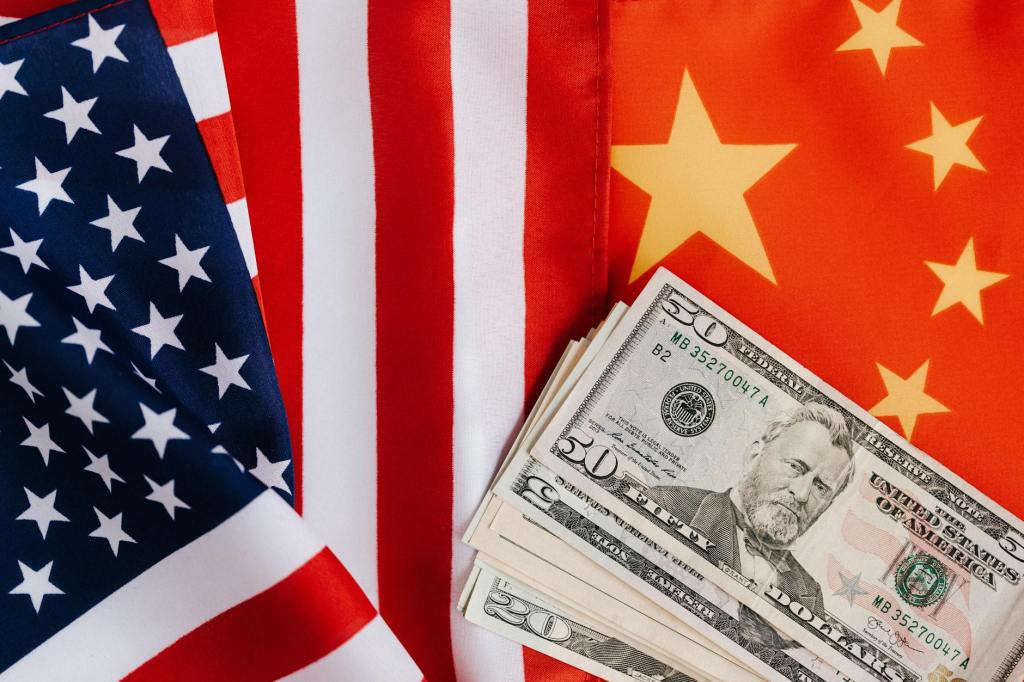
A real-world example of power dynamics and how power affects trade is the current trade war with China and trade conflict with Canada and Mexico. China has been a member of the World Trade Organization (WTO) since 2001 and has been a major trade partner with the U.S. even before they were admitted as a member. Since 2018, however, there have been strained trade relations with China due to President Trump imposing $360B worth of Chinese goods, while China imposed a retaliatory tariff on $110B worth of U.S. agricultural products. (Sutter, 2025) This is a black and white example of economic leverage and global power to affect trade policies. Another form of evidence is seen through Free Trade Agreements (FTO). Previously the North American Free Trade Agreement (NAFTA), the U.S.-Mexico-Canada Agreement (USMCA) is a free trade agreement that mutually benefits North American sectors by fostering a more balanced trade, increasing economic growth, and protecting worker rights across all three nations. Initiated by the United States, this is a great example of a hegemonic power leveraging its position to benefit itself by removing trade barriers and influencing trade policy.
OTHER MEANS OF POWER
When researching the literature on this topic, there seemed to not be much discussion on the military influencing trade. In the literature, military power was discussed as a tool for coercion or intimidation, but rarely made the connection to influencing trade. That is arguably a big component that is missing within the literature. Perhaps this is due to the several interpretations of what power is in the eyes of scholars; is the variable too broad of a scope to analyze? If power were to be better identified, then there might be better research on the outcome of power and trade. The concept of power has several definitions, and an excess of military power can certainly influence trade. According to Gaile and Grant (1989), military power is one possible variant and is measured by one’s defense spending. The United States has historically spent more on their defense budget than any other nation. Gaile and Grant suggest that a portion of this power disparity in trade is due to the sourcing and exchanging of military equipment rather than influencing trade through military force.
CONCLUSION
The relationship of power and how it affects trade is multifaceted; the theoretical perspectives offer a better insight into better contextualizing how power affects trade and influences international economic policies. Realist perspectives such as Krasner’s Hegemonic Stability Theory highlight the role of the hegemonic state, i.e., the United States, in maintaining an open and free trade system, whereas Power Transition Theory highlights the conflict of rising powers in challenging the hegemonic power. The method from which these theories are applied is seen through examples such as the U.S. and China trade war, as well as the free trade agreements like the USMCA. Additionally, the literature focuses on political and economic power yet leaves out military power as a source of influence in trade. Regardless of this oversight, it is evident that the power dynamics between global supply chains, economic and fiscal policies, and political influence all define the sphere of global trade, leading to the conclusion that power affects trade.
Sources:
Krasner, Stephen D. 1976. “State Power and the Structure of International Trade.” World Politics 28(3): 317–47. doi:10.2307/2009974. https://rochelleterman.com/ir/sites/default/files/krasner%201976.pdf
Nguyen, Quynh, Thomas Sattler, and Tanja Schweinberger. 2024. “Great Power Dynamics and International Economic Cooperation: Experimental Evidence from Parallel Surveys in China and the United States.” European Journal of Political Research. doi:10.1111/1475-6765.12748. https://ejpr.onlinelibrary.wiley.com/doi/10.1111/1475-6765.12748
Sutter, Karen. 2025. Congress.Gov U.S.- China Trade Relations. Congress.Gov. https://www.congress.gov/crs-product/IF11284 (March 12, 2025).
Gaile, Gary, and Richard Grant. 1989. “Trade, Power, and Location: The Spatial Dynamics of the Relationship between Exchange and Political-Economic Strength.” Economic Geography 65(4): 329–37. doi:10.2307/143410. https://www.jstor.org/stable/143410
Yazawa, Nobuo. 2023. “Dynamics of International Trade: A 30-Year Analysis of Key Exporting Nations.” PLoS ONE 18(8): e0289040. doi:10.1371/journal.pone.0289040. https://pmc.ncbi.nlm.nih.gov/articles/PMC10393138/
Stephen, Matthew D., and Michal Parízek. 2018. “New Powers and the Distribution of Preferences in Global Trade Governance: From Deadlock and Drift to Fragmentation.” New Political Economy 24(6): 735–58. doi:10.1080/13563467.2018.1509065. https://doi.org/10.1080/13563467.2018.1509065

 MARKETS AND BORDERS